

Ambareen Baig, PMU and Insights Manager, Accelerate Prosperity
Accelerate Prosperity is an entrepreneurship development initiative of the Aga Khan Foundation (AKF) and Industrial Promotion Services (IPS), supporting small and growing businesses (SGBs) across Central and South Asia through technical assistance, financing, and ecosystem engagement.
Across Central and South Asia – particularly Uzbekistan, Kyrgyzstan, Tajikistan, Pakistan, and Afghanistan – climate and environment entrepreneurship is emerging, but it is still structurally constrained. Environmental challenges such as waste management, high energy and input losses in production, water scarcity and pollution, and climate vulnerability are widely recognized. Still, the step from “problem” to scalable, investment-ready business remains difficult.Ecosystem-level evidence points to similar gaps. Only 15 out of 305 businesses surveyed across Uzbekistan, Tajikistan, and Kyrgyzstan – in an FCDO funded Ecosystem Mapping and Market Report on Central Asia in 2025 – were classified as green or greening.1 Of these, just two reported raising any prior investment, and the amounts were minimal. Ten of the fifteen businesses also noted that they were not aware of any startup-focused business development support programmes – such as pre-incubation, incubation, or acceleration. So, the issue is not only deal flow, but visibility, targeting, and fit. As this space continues to evolve and attract more attention from Entrepreneurship Support Organizations (ESOs), investors, and donors, the need for targeted pipelines – and for credible classification and measurement systems to avoid greenwashing – becomes increasingly clear.
In Central Asia, green enterprises tend to cluster around waste recovery, agri-processing by-products, energy efficiency, and sustainable textiles, with many operating informally or at micro scale. The constraints, however, are often less about ambition and more about structure – they tend to surface across policy, market coordination, and capital. The policy architecture is still emerging. Regulatory frameworks related to waste, recycling, and green procurement do exist, but enforcement is uneven, and market incentives are not always strong enough to shift behavior at scale. Additionally, demand is often fragmented, and value chains are weak or incomplete. Even in contexts like the Kyrgyz Republic – where the green economy focus is pragmatic and sector-driven, spanning renewables, energy efficiency, waste, water, and agriculture, shaped by climate risk and energy dependency – coordination across the chain remains thin.
Access to capital is also limited in both Central and South Asian markets. Early-stage financing for green enterprises is not always aligned with their scale or risk profile, which makes the step from pilot to scale difficult. Similarly, South Asia presents one of the clearest cases for green solutions. In Pakistan, where carbon emissions have more than doubled over the past two decades and solid waste has reached 49.6 million tons annually – with only 3% of plastic recycled – green economy models have become increasingly central to both climate resilience and economic sustainability.
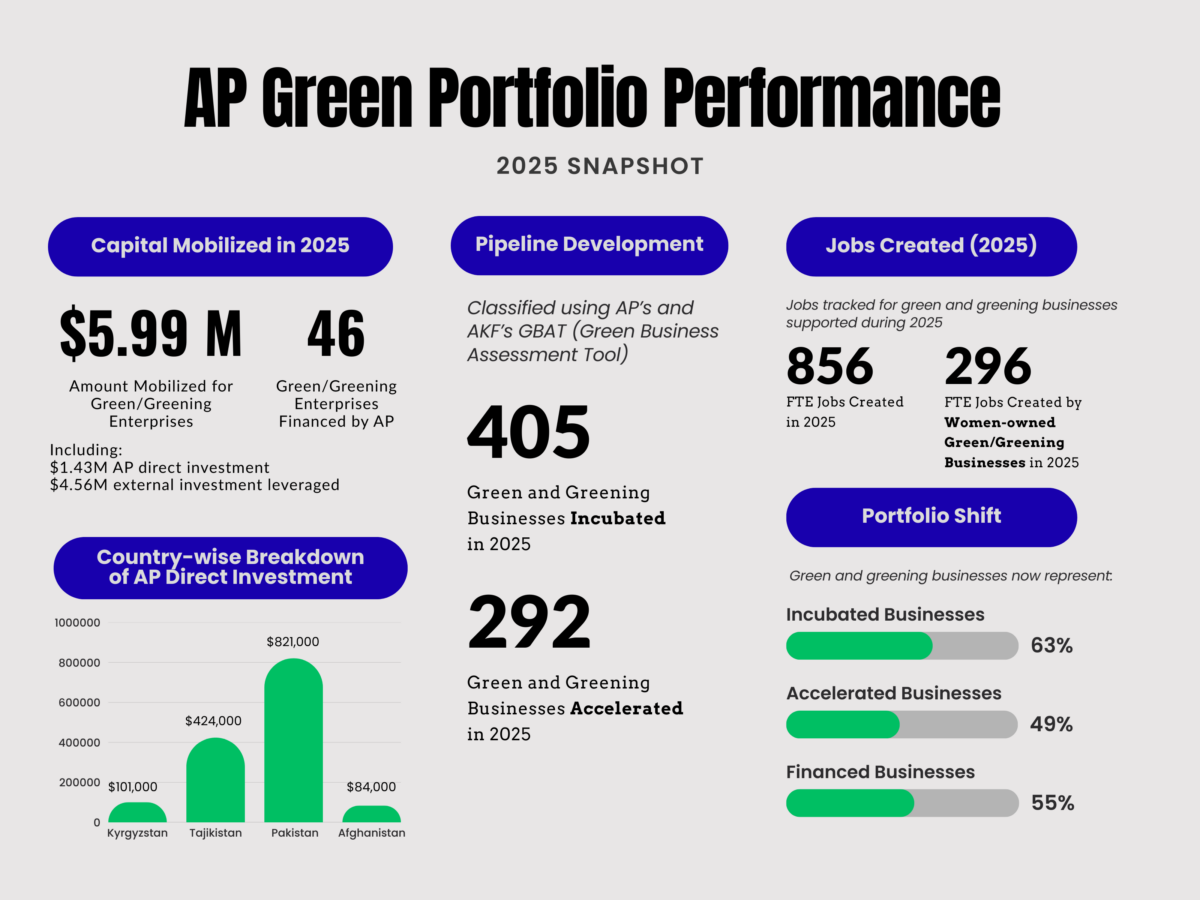
Against this backdrop, AP’s 2025 technical assistance and portfolio data offers a concrete view of investment flows, pipeline development, and enterprise-level outcomes across the region.
One example is Concept Loop in Pakistan, a green construction startup turning low-value plastic waste into pavers and wall panels. Since 2021, it has deployed over 800,000 construction items and diverted more than 600,000 kg of plastic from landfills and oceans. It also works with partners like Shell, EBM, and PepsiCo – not in a symbolic way, but through real supply-chain integration that helps reduce their carbon footprint.
|
|
|
Recycled plastic, reimagined: construction tiles and blocks produced at Concept Loop’s factory, where single-use plastic waste is transformed into durable, low-carbon building materials. |

In Tajikistan, Gofro Agregat is building a closed-loop packaging business by converting paper waste into high-quality cardboard for FMCG and food companies such as Coca-Cola. The model responds to a very practical gap – limited recycling capacity and continued reliance on imported packaging. In the Rushan district of GBAO, Hamdam Davlatmamadov’s greenhouse – the largest in the region – spans 1.5 hectares and produces around 70 tons of tomatoes, bell peppers, and cucumbers annually. The produce is sold locally in Rushan and Khorog, strengthening access to fresh food in a remote, climate-vulnerable area.
|
|
|
Fresh produce at the source: inside Hamdam Davlatmamadov’s greenhouse in GBAO, where year-round cultivation is strengthening local food security. |

Similarly, Ecosport.kg in Kyrgyzstan gives discarded truck tires a second life as rubber tiles and surfacing for gyms and playgrounds – practical circularity, visible in everyday spaces. EcoStart, also in Kyrgyzstan, produces wastewater treatment equipment. Its Membrane Bioreactor systems allow treated water to be safely discharged into natural water bodies or reused in agriculture – which, in water-stressed contexts, makes a tangible difference.
|
|
|
|
Recycled truck tires, repurposed: Ecosport.kg transforms discarded rubber into durable tiles and surfacing for playgrounds and urban spaces in Kyrgyzstan. |
|


|
|
|
|
EcoStart’s wastewater treatment equipment in Kyrgyzstan |
|


EcoStart in Kyrgyzstan specializes in production of equipment for wastewater treatment, including warranty service since 2021. The Membrane Bioreactor technology allows cleaned water to be safely discharged into natural water bodies and soil or be used in agriculture.
Accelerate Prosperity supports climate- and environment-oriented entrepreneurship through an integrated portfolio model rather than stand-alone green programmes. Green businesses operate within the same policy, market, and financing constraints as others, and our approach reflects that reality.
At the enterprise level, AP provides incubation, acceleration, and financing to businesses operating in – or transitioning toward – environmentally conscious models, including recycling, sustainable agriculture, eco-tourism, and resource-efficient manufacturing. To date, AP has financed 709 businesses since 2016,investing between USD 20,000 and USD 200,000 per enterprise and mobilizing USD 65.49 million in external leverage.
Several programs have an explicit climate focus, including the SECO-funded Supporting Accelerated Growth of Entrepreneurship (SAGE) Phase II, the FCDO-funded Central Asia Green Inclusive Growth Fund’s Business Development Services (GIG-BDS) and Central Asia Green Inclusive Growth Fund’s Investment Finance Facility (GIG-IFF) in Central Asia, and the KfW-funded StartUp Pakistan and EU-funded Energy Plus programs. These initiatives combine technical assistance and purpose-fit financing, strengthening green pipelines, and enabling enterprises to move from early-stage experimentation to structured growth.
At the systems level, AP applies its Green Business Assessment Tool (GBAT) across due diligence and portfolio management. It actively collaborates with investors, regulators, donors, and ecosystem partners to strengthen green pipelines, refine environmental screening, and co-design market-relevant support mechanisms.
|
|
|
Participants in AP’s EcoVenture Green and Clean acceleration cohort take part in a hands-on waste segregation exercise, building practical understanding of recyclable versus non-recyclable materials as they develop environmentally focused business models. |

Advice for aspiring entrepreneurs
First, anchor environmental ambition in commercial logic. Green businesses scale when they solve concrete cost, efficiency, or compliance problems – not when sustainability is treated as an add-on. Across Central and South Asia, climate risks translate directly into market needs: coal-dependent energy and winter air pollution in Kyrgyzstan; water stress, glacial melt, flooding, and landslides in Tajikistan; rising flood risk, heat stress, and water insecurity in Pakistan; and prolonged drought, land degradation, and water scarcity in Afghanistan. In these contexts, environmentally conscious enterprises succeed when they address immediate economic pain points while delivering measurable environmental value.
Second, measure early and consistently. Entrepreneurs who can demonstrate environmental performance alongside financial viability are better positioned to attract partners, finance, and policy support.
Finally, think in value chains, not isolated solutions. Circular economy opportunities – especially in waste, agriculture, and textiles – require coordination across suppliers, buyers, and service providers. Collaboration is often the difference between pilots and scale.