

Day Three of the South Asia Convening 2025 explored how South Asia can unlock patient, credible capital for climate and inclusion—through regional collaboration, blended finance, and stronger impact standards that make SGBs investable at scale.
The final day of the South Asia Convening 2025 tackled a defining challenge for the region’s entrepreneurial future: how to unlock patient, intelligent capital for enterprises addressing climate change, waste and social inclusion at scale. Leaders from India, Bangladesh, Sri Lanka and beyond examined how collaboration, blended finance and new measurement standards can accelerate investment in small and growing businesses (SGBs). Sessions covered practical tools, including shared waste management metrics, and fundamental questions about whether capital, conscience or local context matters most in shaping impact investment. The aim was to prompt funders and investors to reconsider how capital flows and whose realities drive decisions.
Building a South Asia Impact Investing Platform
(Anchored & Designed by Lanka Impact Investing Network and GSG Impact Sri Lanka)
Dr. Nirmal De Silva (Co-Founder, Paramount Realty) as moderator, explored practical, achievable pathways, challenges, gaps, and opportunities for how regional collaboration can better support MSMEs and SMEs. Chandula Abeywickrema (Founder and Chairman, Lanka Impact Investing Network) identified structural gaps blocking South Asian SMEs from accessing cross-border capital. “South Asia holds vast opportunities for impact, but small entrepreneurs still struggle to become commercially viable, scalable, and sustainable,” he argued. Without addressing these fundamentals, investors cannot see them as credible partners.
Chalinda Abeykoon (Managing Partner, nVentures) rejected Silicon Valley’s “spray-and-pray” approach for Asian markets, where capital is expensive and 100x returns are rare. He defined two risks: 1) losing money in a failed venture; 2) passing on the right company, which can cost far more over time. He also emphasised regional learning loops: founders in India, Sri Lanka and Bangladesh share playbooks and adapt tactics across markets.
Charlotte Badenoch (Head of Investment Vehicles, GSG Impact) noted that “more and more donors, DFIs, philanthropic foundations are using catalytic capital more deliberately, and really thinking about how they can leverage their catalytic capital to bring in more private sector investors.” South Asia could position itself as “a testing ground for blended finance,” particularly for climate resilience, SME growth, digital inclusion, and gender. Getting ahead of mandatory impact disclosure rules could give the region an edge.
The session examined how South Asia can move “from ecosystem to collaboration” in impact investing by tackling SME gaps in commercial viability, scalability, and sustainability, and by building stronger, investor-ready pipelines. It highlighted focused instruments and strategies such as revenue-based finance, blended finance, and thesis-driven co-invested funds, while positioning South Asia as a testing ground for innovative structures, local capital mobilization, and Global South-South knowledge sharing.

Sneak Peek – IRIS+ Circularity Metrics
(Anchored & Designed by Global Impact Investing Network (GIIN) and Circulate Capital)
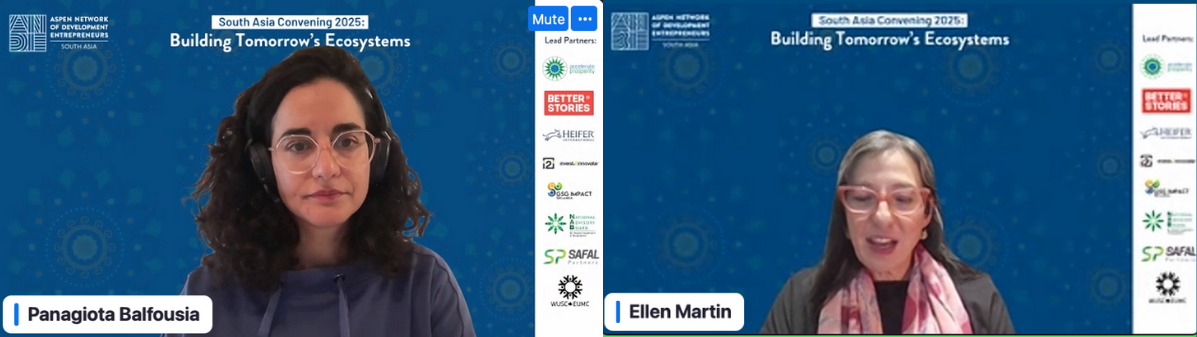
Panagiota Balfousia (Director IRIS+/IMM, Global Impact Investing Network (GIIN)) introduced IRIS+, a free toolkit for measuring and managing impact that helps investors make more informed decisions and deliver stronger outcomes for people and the planet. The IRIS+ Waste Management and Circularity theme targets four goals: minimizing waste through circular design; maximizing product utility and lifespan; optimizing recycling infrastructure; and ensuring equitable supply chains.
Ellen Martin (Chief Impact Officer, Circulate Capital), said investors must work across the full value chain and invest in diverse solutions. Her fund’s first India investment, a flexible film recycler, scaled capacity 20 times since 2019, reaching 90 per cent recycling yield. The fund evolved from tracking jobs created to measuring livelihood improvements, training quality and gender inclusion across formal and informal waste sectors. These metrics guide their quarterly portfolio reviews and future investment decisions.
Capital, conscience, or context?
(Anchored & Designed by National Advisory Board (NAB) Bangladesh)
Erad Kawsar (Executive Director, Build Bangladesh) highlighted impact investing’s remarkable ascent, citing the Global Impact Investing Network’s (GIIN) 2024 report showing $1.58 trillion mobilized since 2010. This cements its transition from niche experiment to essential engine for aligning profit with purpose.
Addressing how impact investing is changing traditional valuation models, Dr. Ilex Lam (Chairman, iEnterprise Foundation) explained that Hong Kong family offices typically evaluate deals on financial returns first, then overlay social benefits. “We need to articulate clearly what kind of impact, and how this impact can be measurable, and how it can be monetised,” he said.
Leena Pishe Thomas (Director and Principal Consultant, Global Business Inroads (GBI)) stressed that “proof over promise” is non-negotiable. Investors want technologies with intellectual property and proven deployment in their home markets (Europe or the US). They insist on testing with regional inputs before approving tech transfer agreements and turning innovations into bankable business models.
Atika Benedikta (Executive Director, Indonesia Impact Alliance) emphasized that while financial returns remain paramount, impact investing is shifting toward accountable, verifiable data and sophisticated frameworks, driven by impact-first capital and ground-level founders. Atika also highlighted how Indonesia’s impact deals evolved from VC-style equity to hybrids, “Some part of the capital will be used for the impact achievement, and some others are used for the commercial growth, and that is blended together.”
In blended finance models, Rohma Labeeb (Country Director, Accelerate Prosperity) described how Pakistani entrepreneurs accept lower financial returns for greater social impact. She said, “You assess your Social Return on Investment (SROI) against traditional ROI, weighing trade-offs like prioritizing 10x SROI over 10x ROI. This means accepting perhaps just 1x ROI. It involves compromising on business growth (while maintaining financial sustainability) to maximize impact.” She also discussed how Accelerate Prosperity backs 150-plus Pakistani startups while maintaining strict financial discipline and tracking impact over five to seven years.
This session showed impact investing driven by capital (demanding bankability), context (local efficiency), and conscience (SROI trade-offs). Panelists urged overlaying social returns on financial models, proving pilots, and blending loans, unlocking scale for South Asia’s climate and inclusion goals.

Day Three of SAC 2025 revealed a clear framework: patient capital that bridges global standards with local realities can transform South Asia’s fragmented markets into scalable ecosystems. By overlaying social returns on financial models, proving concepts through pilots and blending concessional loans with equity, the region is building infrastructure for climate and inclusion investments. Yet success hinges on whether funders will accept lower financial returns for measurable social impact and whether founders can close the viability gap fast enough to meet investor timelines.