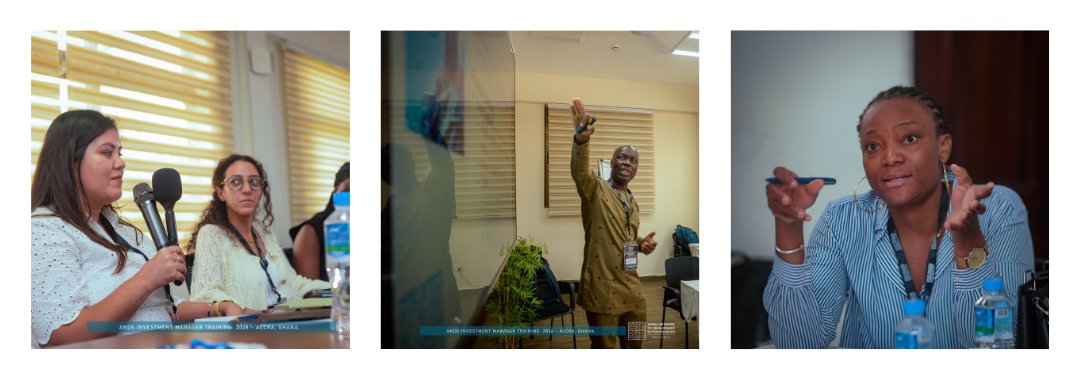
ANDE’s flagship Investment Manager Training convened investors in Ghana to strengthen capital deployment for climate innovation across agribusiness and food systems
Climate risk is showing up on balance sheets across food systems—yet most capital is still structured for predictability. In Accra, the Investment Manager Training (IMT) focused on how investors can structure for volatility without diluting discipline
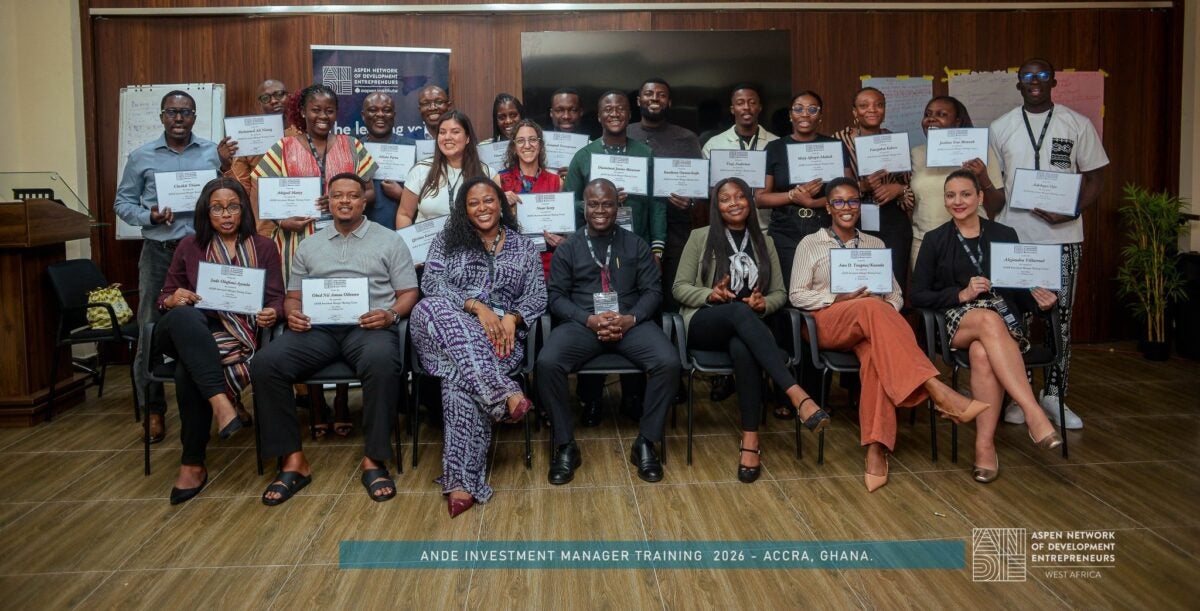
The five-day, in-person training brought together 23 investment professionals from West Africa, the Netherlands, and Canada, reinforcing ANDE’s commitment to strengthening investment capacity where it matters most.
Led by expert trainers Sewu-Steve Tawiah (Jaza Rift Ventures) and Winfred Kumi (AV Ventures LLC, the training challenged participants to move beyond generic “impact” framing toward rigorous, commercially sound investment strategies.
But beyond technical capacity building, the Accra IMT surfaced deeper lessons about how capital must evolve to unlock climate-resilient food systems.
Climate innovation requires a value chain approach
A core insight from the training was that climate solutions in agribusiness cannot be treated as a standalone vertical. Instead, they must be embedded across the entire food value chain, including:
- Upstream production
- Processing and aggregation
- Distribution and logistics
- Value Chain Expansion
Participants explored innovations such as renewable energy integration, waste-to-value models, climate-smart inputs, and efficiency technologies. This value chain framing broadened investors’ understanding of where capital can drive both margin creation and climate impact simultaneously.
The implication is clear: climate investing in food systems requires systems thinking, not siloed capital allocation.
Capital structure is strategy, not simply financing
Throughout the week, investors engaged deeply with the design of capital instruments, examining equity, quasi-equity, debt, and blended approaches as strategic tools rather than financing defaults.
A recurring theme was that hybrid instruments are particularly relevant in emerging markets because they help address:
- Cash flow volatility
- Growth capital gaps
- Governance alignment challenges
- Risk-return balancing
Participants recognized that instrument selection must align with business lifecycle stage, capital intensity, and revenue predictability. In markets where collateral is weak and governance structures are evolving; creative structuring can unlock financing without overburdening enterprises.
Governance is the hidden driver of investment success
Across sessions on valuation, term sheets, and post-investment monitoring, a consistent message emerged: governance is alpha in emerging markets.
Discussions highlighted how governance mechanisms, from board participation to liquidation preferences and control rights, shape both investor protection and enterprise growth trajectories. Importantly, the training emphasized a shift from “nice capital” to disciplined capital, where enforcing rights is essential to sustaining ecosystem credibility.
This insight was reinforced during fireside conversations featuring investor perspectives from Isaac Asomani and George Sognon, alongside entrepreneur Catherine Krobo Edusei, whose candid reflections illuminated the practical realities of capital deployment and fundraising.

Investors must pair capital with capability
Sessions on impact measurement and post-investment support underscored that capital alone is insufficient to drive enterprise success.
Participants examined frameworks including Theory of Change, IRIS+, and SDG alignment while exploring how technical assistance, data analytics, and capacity development contribute to value creation. The training reinforced that post-investment engagement is often the primary driver of both impact and returns.
This perspective was further strengthened by Nelson Madiba Amo, whose enterprise support organization (ESO) lens highlighted the growing convergence between investment and enterprise support roles.
Working capital discipline determines survival
Through case studies and valuation exercises, investors repeatedly encountered the operational reality that working capital constraints represent one of the greatest threats to SGB sustainability.
Concepts such as the J-curve and Valley of Death illustrated how early-stage burn, liquidity strain, and working capital absorption can derail promising ventures without disciplined capital sequencing and investor patience.
For agribusiness enterprises in particular, where seasonality and supply chain dynamics amplify cash flow volatility, this insight carries heightened relevance.
Technology is reshaping investment practice
Another emerging theme was the integration of digital tools and generative AI across the investment lifecycle. Participants explored how AI can support:
- Pipeline development and screening
- Investment memo preparation
- Due diligence analysis
- Portfolio monitoring
While still evolving, these tools signal a shift toward data-augmented investment decision-making, with implications for efficiency and pipeline quality in frontier markets.
Moving towards a maturing climate investment ecosystem
West Africa’s investment landscape is reaching a tipping point, evolving from simple funding into a sophisticated ecosystem where impact and profit finally shake hands. While hurdles like information gaps and pipeline quality remain, the IMT proved that the future of climate resilience lies in radical collaboration, uniting investors, entrepreneurs, and policymakers.
High-impact climate innovation isn’t a luxury; it’s a necessity. To get there, the agribusiness sector must embrace flexible capital and tech-enabled systems. Through the IMT, ANDE is empowering investors to deploy capital where it matters most: at the intersection of entrepreneurship, climate resilience, and food security.
The blueprint for impact is ready; now, it’s time to fund the future.