
This content is also available in: Español
Author: José Ibañez
For years, efforts to strengthen entrepreneurship ecosystems have treated them as if they were machines: resources go in on one side, and successful companies are expected to come out the other. But reality has shown that this linear approach does not work.
Cities are not machines. They are living systems, constantly changing and shaped by less visible dynamics of power, culture, and trust. Every intervention creates ripple effects. That is why it is time to move beyond one-size-fits-all models and adopt an approach that is more contextual, more strategic, and more realistic.
How to avoid repeating the mistakes of the past
Historically, support for entrepreneurship has been full of good intentions, but not always strong execution. Some failures come up again and again:
Stakeholders working in isolation. Governments, universities, funds, and support organizations often operate separately, without a shared strategy.
Programs that treat symptoms, not causes. Funding goes to isolated projects or short-term subsidies instead of addressing structural barriers.
Imported models with no local adaptation. External approaches are replicated without understanding the territory’s actual constraints, maturity, or economic vocation.
A disconnect from ecosystem maturity. Sophisticated programs are introduced when what is really needed is entrepreneurial culture, trust, or basic capabilities.
An ecosystem can bring together all the right actors and still function poorly if they remain disconnected. What determines performance is not the hierarchy among the parts, but the way they relate to and coordinate with one another.

Precise diagnosis for strategic action
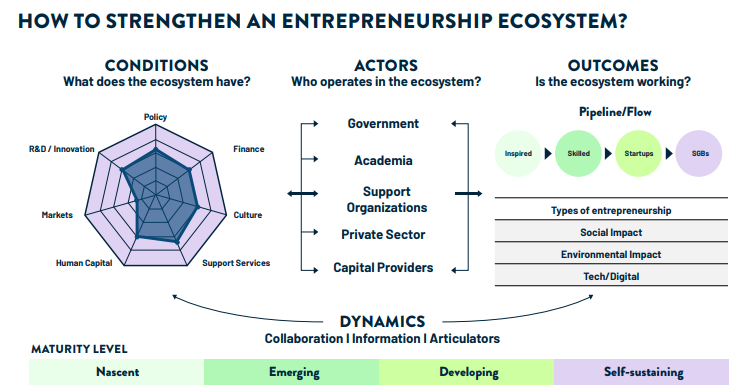
We cannot transform what we do not understand. To move beyond intuition and toward evidence-based decisions, ANDE’s entrepreneurship ecosystem diagnostic model begins with three central questions:
What conditions shape the ecosystem?
The model evaluates seven key domains: public policy, finance, culture, support services, markets, innovation and development, and human capital. This makes it possible to identify the main bottleneck limiting development.
Who is involved, and how do they interact?
It maps the roles of government, academia, support organizations, the private sector, and capital providers to understand where coordination exists, where gaps remain, and where efforts overlap.
Is the ecosystem actually working?
It analyzes the real path an entrepreneur follows, from initial inspiration to the creation of a startup or a small and growing business.
The methodology uses three main tools:
Domain radar. Identifies which conditions are in place and, above all, where the main constraint lies.
Stakeholder map. Detects gaps in service, concentrations of effort, and fragile dependencies.
Coverage map. Shows where the entrepreneurial journey breaks down—from inspiration and training to business creation and growth—and helps assess whether social, environmental, and technology-driven ventures are being supported.
What is the ecosystem’s maturity level?
The ANDE model classifies ecosystem maturity into four stages, or “generations,” based on a system’s ability to strengthen and renew itself over time.
Nascent. There is heavy dependence on government, entrepreneurial activity is still limited, and there are not yet founders reinvesting in the system.
Emergent. The first success stories begin to appear and early support networks start to form, although entrepreneurs remain focused primarily on building their own companies.
Developing. The system begins to function in a more coordinated way, startups target broader markets, and some successful founders start giving back to their community.
Self-sustaining. There is a high density of startups and small and growing businesses, a more consistent flow of capital, and founders who, after successful exits, return as angel investors, mentors, or ecosystem builders.
AI as a catalyst
Ecosystem studies used to require long periods of manual information gathering and organization. Today, integrating artificial intelligence can accelerate the processing of data, indicators, and public sources, reducing analysis time and making it easier to generate a clearer reading of the ecosystem.
AI helps review databases and public reports, structuring information into findings that are clearer and more actionable. This frees up time for what remains essential: interpreting context, designing relevant interventions, and working directly with the organizations that sustain the ecosystem on the ground.
That balance between technological capacity and field experience is part of the value ANDE has built over more than 15 years of working alongside business development actors in emerging markets.
The road ahead
An effective intervention recognizes the stage of evolution of each city or territory, identifies the main bottleneck, and helps build a virtuous cycle in which successful entrepreneurs reinvest in the next generation.
Today, a more precise diagnosis no longer has to take years. It can be the first step toward directing resources more effectively, aligning ecosystem actors, and designing changes that are more likely to last.
If you want to learn more about how to apply this approach in practice, ANDE’s entrepreneurship ecosystem diagnostic can be a strong place to start. The tool helps bring greater clarity to what is happening in a given territory and supports more strategic decisions based on evidence, not assumptions. You can explore the model and its scope here.