What Six Studies Taught Us About Supporting Women in Clean Energy
“Now we have more light — but we’re still the same. Just now the day lasts longer.”
A woman named María said that to researchers studying how rural Mexican households were adapting to new solar energy. Her words matter because they gently question how the clean energy sector has seen women over the last twenty years.
The new light was real. Water heated up faster, and evenings lasted beyond sunset, making the path safer at night. Still, some important things stayed the same for María and many other women in the six research projects. These lessons show what the sector has often missed.
An assumption the sector had stopped questioning
For years, many believed that the main barriers for women-led clean energy businesses were technical and financial. The idea was simple: improve the product, close the funding gap, and the rest would work out.
From 2024 to 2026, ANDE, the International Development Research Center (IDRC) of Canada, and 2X Global set out to test this idea. They chose six research teams from over fifty proposals across Latin America, the Caribbean, and Sub-Saharan Africa. Each team looked at what really helps women-led clean energy businesses grow, using different methods: a thousand-hour ethnography in Mexico, a survey of 474 alumni in Nigeria and Tanzania, an eighteen-month machinery project in Uganda, a feasibility study in the Caribbean, an action-research project in South Africa’s solar sector, and a community of practice for cleantech founders in Chile.
All the teams reached the same conclusion. The biggest barriers were the ones no one was measuring: confidence, cultural expectations, lack of information, and unequal care duties. Since these findings appeared in different studies, they are hard to ignore. When research in Chile, Mexico, and Nigeria all highlight the same issues, it is not just about the research method.
What the studies found
 Uganda gave the clearest example. The National Association for Women’s Action in Development and Makerere University built semi-automated briquette machines to make production less physically demanding, a job mostly done by men. The machines worked: they made the work easier and, with new covered drying rooms, made production less dependent on the weather. But the team found that the machines did not change who used them. Existing roles in the businesses still decided who operated the equipment. This direct test of the common idea that giving women better tools would change their roles showed that the tool was not the real barrier.
The Mexican ethnography, led by Bitácora Social and Irrazonables, found something similar. Women installed solar panels and water heaters at home and saw them as practical improvements, not big changes. They liked how these upgrades made daily life easier, not because of any future promise. One woman said she no longer had to rush to finish her work before dark. The technology helped, but the real influence was the household’s existing roles and decision-making.
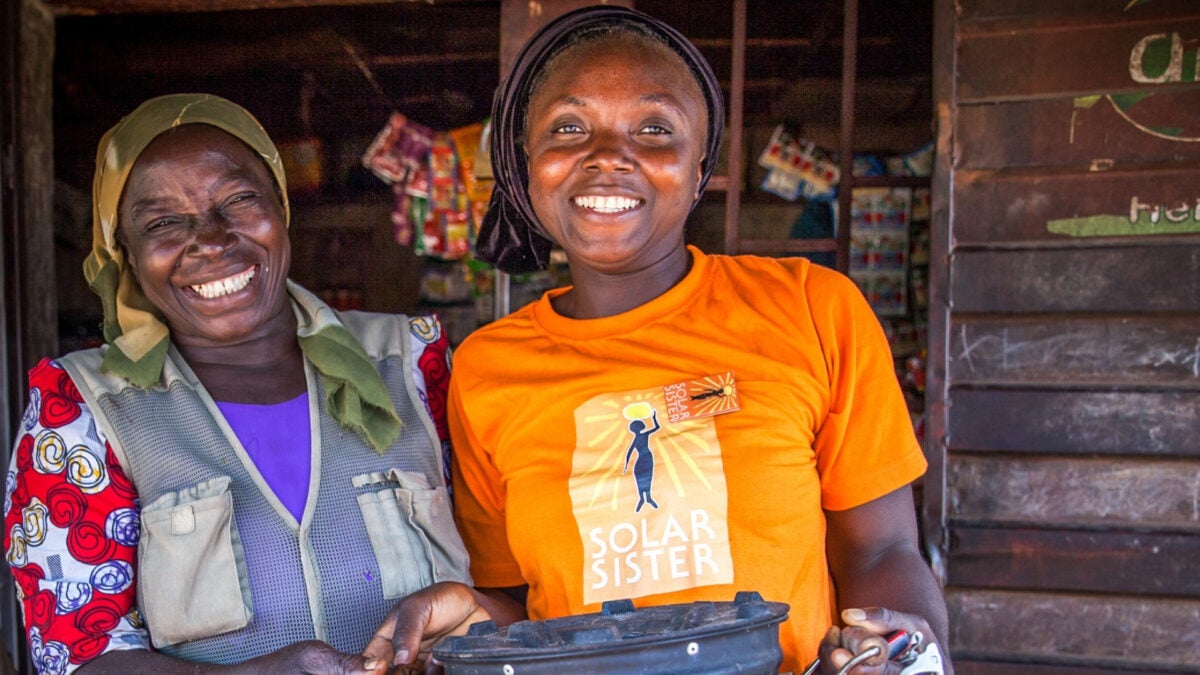
Nigeria and Tanzania taught a practical lesson. When Solar Sister and 60 Decibels surveyed program graduates, they found that the biggest factor in a woman’s success was not the solar product she got, but whether she finished the training. More than two-thirds of graduates started new ways to earn money beyond solar, and these women were twice as likely to report big improvements in their quality of life. The business was just the beginning; the real value was the skill, which could be used elsewhere. Solar Sister also found that empowerment looked different for each woman. Some valued control over income, others valued joint decision-making, mobility, safety, or status. This shows that using only one measure will miss the full picture. The study’s advice was to start by listening, then create measures together with the women themselves.
This pattern showed up again. In South Africa, Indalo Inclusive and The Broker found that confidence and emotional strain, often seen as personal weaknesses, are actually responses to outside pressures, with outside causes and solutions. Some skilled women doubted themselves before even starting (“I’m not confident, I cannot do any business”). The organizations that succeeded saw confidence as something that can be built through practice and experience, not something a woman simply has or does not have. In Chile, Mujeres Empresarias and the Universidad de Concepción saw that when support was offered as a community instead of an accelerator, almost everyone stayed in the program. In the Caribbean, Caribshare and UTEC did more than just recommend a regional cooperative. By February 2026, women entrepreneurs in seven countries had already formed the region’s first women-led renewable energy cooperative, even before the research was published.
What this means for the sector
The studies all point to a hopeful conclusion, but with one important condition. Support for women-led clean energy businesses works, as proven across six countries, when it is designed with women, based on their real-life situations, and continues beyond a single project.
For funders, this means designing for the whole person and meeting women where they are. A strict, step-by-step funding model is not neutral. It favors an imagined entrepreneur with flexible time and existing resources, and leaves out real women. It also means measuring what women say matters, not just what is easiest to track, and visiting in person. As one participant said, donors who do not visit often miss the real challenges of running a business.
For organizations that support entrepreneurs, it means building with women, not just for them, and making sure what is built lasts. The efforts that lasted were those rooted in networks, like alumni relationships that kept groups connected for years, communities that kept members involved, and cooperatives that continued after the study ended. The real product is not the program itself, but the ecosystem around it.
For policymakers, this means seeing visibility as a kind of access and recognizing care as a real energy issue. If a woman-led business cannot be found in any database, it might as well not exist. The care duties that limit women’s participation are not separate from the energy issue—they are part of it. The daily work often seen as a barrier is actually the kind of judgment the sector needs to value.
The day lasts longer. For the women in this research, it already does — the evening extended, the path lit, the work no longer racing the sun. The question these six studies leave the sector with is: what will be built in the hours that did not exist before, and who, this time, will be supported to build it.
The six studies and the initiative’s learning brief, “What It Actually Takes to Support Women in Clean Energy,” are available on the project’s landing page.
The initiative was led by ANDE in partnership with IDRC (Canada) and 2X Global.
Interested in ecosystem transformation and not an ANDE member? Learn more about the benefits of membership. Subscribe to ANDE’s newsletter for updates on the agenda, speakers, and registration for the Global Annual Conference 2025.