Gender inclusion emerged as another important focus at the ANDE Pan-Asia Convening 2026 (PAC 2026), with participants exploring how organizations can move beyond supporting women entrepreneurs externally to embedding gender equity within their own institutions. Through discussions around the Gender ROI™ framework, this session, led by Sweef Capital, encouraged investors, accelerators, and ecosystem builders to examine their internal practices, decision-making processes, and capital allocation strategies, offering practical tools to measure and strengthen gender-inclusive outcomes.
Brianna Losoya-Evora, Director of The Sweef Institute and Sweef Capital’s Head of Impact Measurement and Management, kicked off the session by introducing the philosophy behind Singapore-based Sweef Capital, a women-owned, women-led investment firm that views gender inclusion as more than simply backing women-founded businesses. Instead, the firm looks at how companies create opportunities for women across leadership, the workforce, value chains, products, and communities. As the team worked with portfolio companies to strengthen these outcomes, they recognized the need for a practical way to measure progress over time. That realization led to the development of the Gender ROI™ framework.
Brianna walked participants through the Gender ROI™ framework, explaining how it measures gender inclusion across 24 indicators spanning leadership, workforce, value chains, and societal impact.
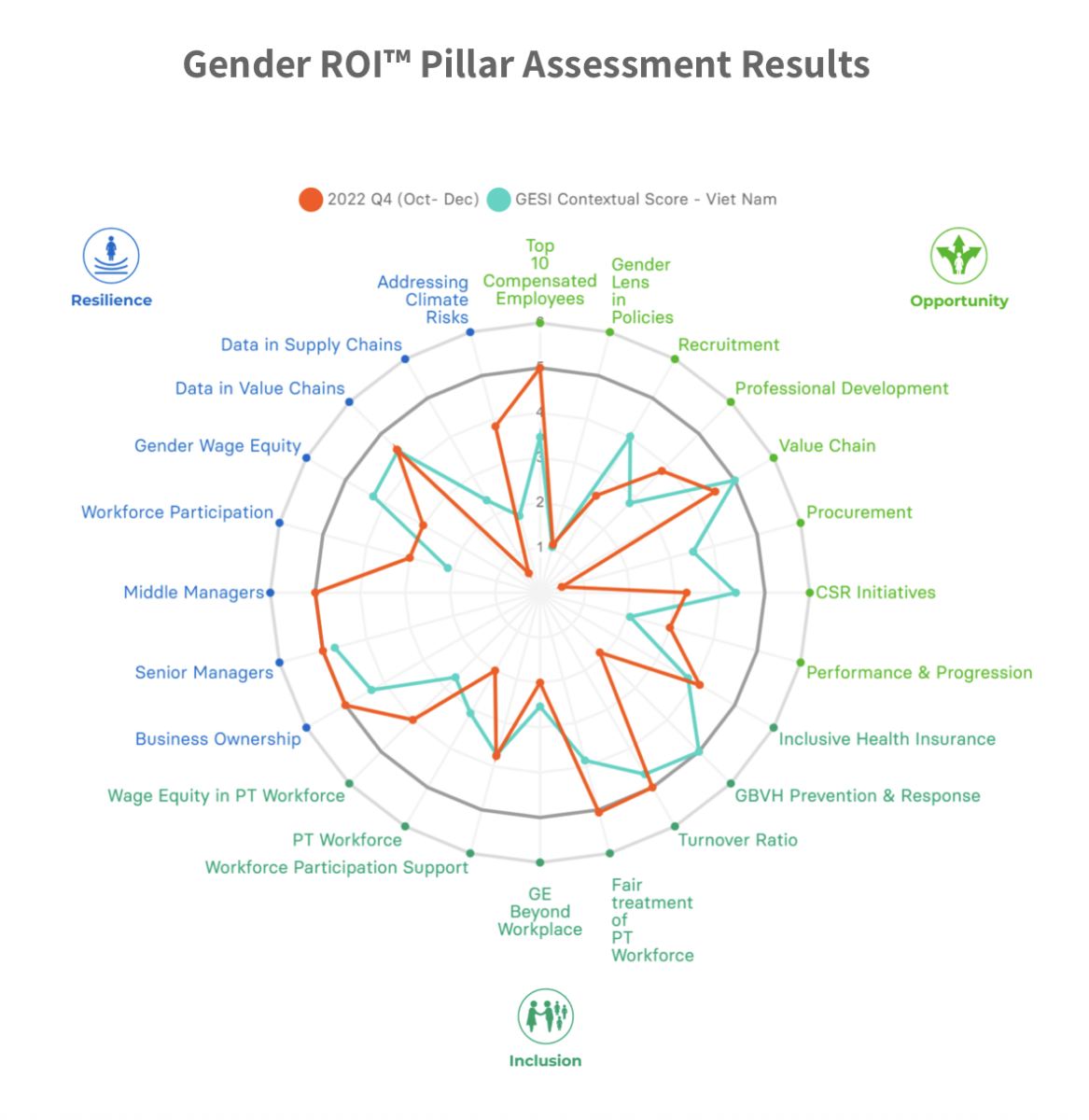
Rather than viewing gender solely through the lens of representation, the framework examines everything from wage equity and leadership opportunities to gender-responsive procurement, workplace policies, climate resilience, and community engagement. Designed to be adaptable for organizations of different sizes, the tool helps users identify strengths, uncover gaps, and develop practical action plans, reinforcing that the goal is not to achieve a perfect score, but to make meaningful progress over time.
The session then gave participants the opportunity to score their organisations within the Gender ROI™ scoring tool. Rather than serving as a one-time assessment, the tool is designed to help organizations translate their scores into a practical Gender Action Plan. Using a structured set of indicators, it encourages organizations to evaluate everything from recruitment and leadership diversity to pay equity, procurement practices, workplace policies, and accountability mechanisms. Importantly, the emphasis is not on achieving a perfect score, but on identifying priorities, tracking incremental progress, and embedding gender inclusion into everyday decision-making.
As participants compared their scores and reflected on the exercise, the discussion shifted from measurement to action. Brianna encouraged organizations not to be discouraged by low initial scores, emphasizing that every organization needs a baseline before it can improve. The framework is designed to identify practical, achievable next steps, whether formalizing workplace policies, improving communication around existing practices, strengthening procurement processes, or introducing more structured accountability mechanisms. Rather than rewarding perfection, the tool recognizes incremental progress and helps organizations build a realistic gender action plan based on their own priorities.
The session also explored how the framework could be adapted across different contexts, from nonprofits and entrepreneur support organizations to local governments. Brianna noted that while some quantitative indicators, such as pay equity, require more time and data to address, qualitative indicators around policies, leadership commitment, and organizational practices offer an accessible starting point for resource-constrained organizations. Looking ahead, The Sweef Institute aims to expand adoption of the Gender ROI™ framework, using anonymized data from participating organizations to better understand the relationship between gender-inclusive practices and organizational performance. As the session concluded, participants were invited to adopt, test, and contribute to the evolution of the tool, underscoring that gender inclusion is not a compliance exercise, but a continuous process of learning, measurement, and improvement.
As ANDE continues to strengthen entrepreneurial ecosystems across Asia, tools like the Gender ROI™ framework offer a practical way for organizations to translate their commitment to gender inclusion into measurable action. By encouraging continuous improvement rather than one-time assessment, the framework helps investors, accelerators, entrepreneur support organizations, and businesses embed inclusion into everyday decision-making. Ultimately, the session made clear that meaningful change begins with measuring where an organization stands today, and using those insights to build more inclusive, resilient, and high-performing organizations.

Day 1 of the ANDE PAC 2026 focused on the foundations of strong entrepreneurial ecosystems. Across keynote discussions and thematic sessions, speakers explored how collaboration, data-driven decision-making, inclusive program design, and ecosystem partnerships can create the conditions for entrepreneurs to thrive.

Day 2 of the ANDE Pan-Asia Convening 2026 explored practical approaches to supporting entrepreneurs through stronger ecosystems.

Day 3 of the ANDE Pan-Asia Convening 2026 focused on one of the defining questions facing entrepreneurial ecosystems today: how can artificial intelligence (AI) be adopted in ways that strengthen, rather than replace, human expertise?

AI is rapidly becoming part of everyday work across the social impact sector, but for many organizations, the challenge is no longer whether to adopt AI; it is how to do so responsibly and effectively.

Human or AI? Our lively, hands-on session co-led with Satu Creative explored why trust, intuition, ethics, and purpose continue to matter in business, investing, and ecosystem building, even as AI transforms the way we work.